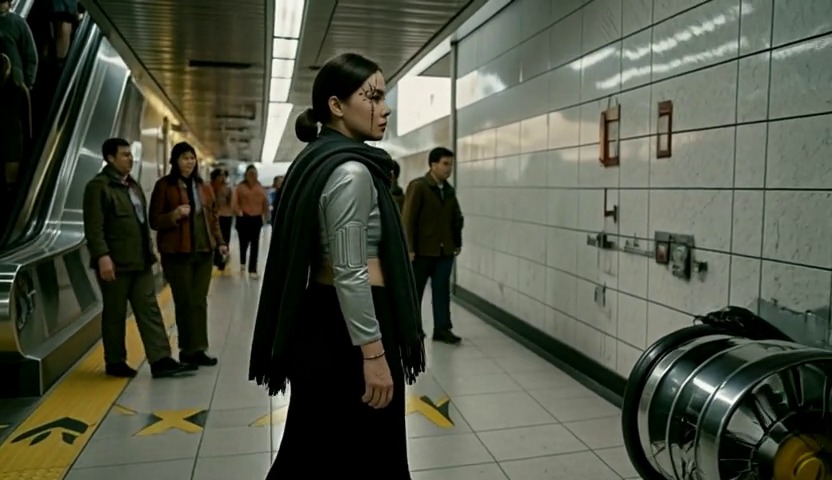
Axi’s scarf has changed to a short cape. Retrieved history and the generated result keep the old scarf.
Outdated appearance
01 Previous appearance
The history we want to remember.
02 Retrieved reference
Relevant to the past.
03 Composed keyframe
The old look is carried forward.
04 Generated clip Mismatch
Wrong for the present.
Stills from earlier Track-B rollouts, shown in the paper’s Figure 1. One retrieved reference is displayed. These illustrate failure paths; they are not fixed-history causal interventions or samples from the main quantitative rerun.
Remembering an entity is only half the problem. Memory must also respect what has changed.
Retrieval helps the right entities reappear. It also brings in entities that should be absent. A single consistency score misses this trade-off.
No memorySelected retrieval policyAbsolute rates · higher is better for all three
30 stories · 2,824 five-second segments per condition · seed 2026 · FLUX.2 + Wan2.2. Differences and 95% intervals use paired story-clustered bootstrap; they do not cover generation-seed variability.
See all four policies and the no-memory control +
Absolute entity outcomes under the shared generator
Condition
Recall ↑
Precision ↑
Avoid-OK ↑
03 / A HIDDEN SHORTCUTAppearance-stripping analysis
Did memory remember? Or did the prompt tell it?
A character can return after a long gap even with no visual memory, because the current prompt describes the character’s appearance.
On the same 62 long-gap character-return events, removing the appearance information sharply reduces no-memory presence. Long-gap success alone is insufficient evidence of visual-memory use.
Targeted prompt intervention; these are entity-presence rates, not proof of identity fidelity or a memory-capacity scaling law.
NO MEMORY · LONG-GAP CHARACTER PRESENCE
Original prompt98.4%
Appearance stripped56.5%
Same event cohort. Different information in the current prompt.
04 / TWO COMPLEMENTARY TRACKSSelection → generated outcomes
Measure the evidence. Then measure its use.
Track A evaluates reference selection before generation. Track B evaluates the generated pixels. They answer different questions on different instances.
TRACK A
What did memory retrieve?
Choose references before the current real segment is revealed; observe the segment afterward.
Prompt→Retrieve→Score references
92real films16,548segments
No generator confound. The scoring gold is never an input to the method.
TRACK B
What did the generator render?
Generate causally from prompts and the system’s own history. Evaluate the entities and states that appear.
Retrieve→Generate→Observe
30evaluated stories2,824segments / condition
Four retrieval policies, no memory and a separate gold-ID Last-seen diagnostic control.
The 30-story evaluated cohort is part of a larger 50-story authoring pool. The two tracks are not matched instances, so Track-A scores cannot be directly correlated with Track-B outcomes.
05 / WHAT TO TAKE AWAYFor builders and evaluators
Ask three questions before you retrieve.
01
What information is valid now?
Historical fidelity is useful only when the remembered state still agrees with the current story.
02
What else comes with that reference?
A needed entity may share its frame with a forbidden character, a look-alike or an obsolete appearance.
03
What did the prompt already supply?
Separate gains from visual history from successes explained by the current prompt itself.
What the study establishes, and what remains open
The main comparison measures complete retrieval policies on one shared generator, conditional on one rollout per story. Histories diverge, so it does not isolate the causal effect of replacing a single reference. The paper also reports second-judge and eight-story H3 sensitivity checks. Absolute rates depend on the judge, and the backend check has limited scope. Last-seen has privileged gold-ID access and variable reference counts; it is not a deployable method or a budget-matched upper bound. The 224-unit mechanism audit was performed by one author and does not estimate population failure frequencies.
1 University of Science and Technology of China · 2 KlingAI Research · 3 Tsinghua University · 4 The Hong Kong University of Science and Technology · 5 City University of Hong Kong
* Co-corresponding authors · ‡ Project leader † This work was conducted during the author’s internship at KlingAI.
BibTeX
@misc{chen2026vmembench,
  title={More Memory, Better Videos? A Controlled Study of Visual Memory in Long-Video Generation},
  author={Chen, Yuzhuo and Shi, Huafeng and Wang, Xinyu and Xu, Yulong and Wang, Yucheng and Hong, Haoqin and Zhang, Guoxin and Ma, Zehua and Zhang, Weiming},
  year={2026}
}